
In the high-stakes world of logistics, “Peak Season” is no longer a predictable surge on a calendar. In 2026, market volatility, rapid e-commerce shifts, and global supply chain fluctuations have made labor management a year-round battle. For warehouse directors, the difference between a record-breaking quarter and a logistical nightmare often comes down to one factor: Workforce Capacity Expansion.
This comprehensive playbook outlines how to move beyond “filling seats” and toward a sophisticated contingent staffing strategy that leverages a warehouse staffing agency as a core operational partner for modern logistics workforce management.
Why Warehouses Face Chronic Labor Gaps in 2026: Understanding the Warehouse Labor Shortage
The labor shortage isn’t just about “help wanted” signs; it’s a structural misalignment in the modern economy. Understanding why the gaps exist is the first step toward fixing them and improving warehouse workforce planning.
- The Technical Skills Gap: Modern warehouses are “Smart Facilities.” We no longer just need manual lifters; we need skilled trades and technical experts who can troubleshoot automated conveyors and manage drone-assisted inventory.
- The “Gig” Competition: Potential employees now weigh warehouse roles against the flexibility of the gig economy. If a warehouse offers zero flexibility, it loses talent to ride-sharing or delivery apps, intensifying the modern warehouse labor shortage.
- Demographic Inversion: As the veteran workforce retires, there is a literal shortage of human hours available in key industrial hubs, forcing companies to rethink their logistics staffing solutions and workforce strategy.
- The Cost of “Emergency Staffing”: Relying on last-minute hires without a strategy leads to a 25% increase in safety incidents and a 30% drop in picking accuracy. This is why organizations increasingly rely on emergency staffing solutions delivered through specialized logistics partners.
The Strategic Role of a Warehouse Staffing Agency in Modern Logistics Workforce Management
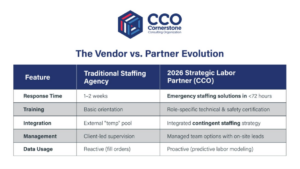
In 2026, a top-tier warehouse staffing agency functions more like a consultancy than a vendor. They provide supply chain gap support by analyzing your data to predict when you’ll need more hands on deck.
Leading operations consulting firms increasingly combine workforce strategy with operational improvement initiatives. Through integrated supply chain management consulting and operations consulting services, organizations can build scalable staffing models that adapt to seasonal volatility.
Many modern distribution centers now partner with a business operations consulting firm that integrates staffing strategy with operational throughput optimization, ensuring labor planning aligns with overall facility performance.
Proven Shift Models for Maximum Throughput in Peak Season Warehouse Staffing
Static 8-hour shifts are becoming obsolete. To capture the best talent and maintain 24/7 operations, warehouses are adopting “Agile Scheduling” models designed for modern peak season warehouse staffing.
1. The 4×10 Compressed Workweek for Flexible Warehouse Workforce Planning
- The Structure: Four 10-hour days followed by three days off.
- The Benefit: Reduces employee “commute fatigue” and increases retention by 15%.
- Staffing Agency Tip: Use contingent staffing to cover the three-day “gap” created by the rotating core team.
2. The Weekend Warrior (3×12): A Model for Peak Season Warehouse Staffing
- The Structure: Three 12-hour shifts (Friday–Sunday).
- The Benefit: Maximizes facility utilization when full-time staff prefer time off. This is a prime area for supply chain gap support.
3. Flexible Tiering (The “Bellows” Model) for Workforce Capacity Expansion
This is the most resilient model for 2026. You maintain a “Tier 1” core of permanent employees and a “Tier 2” of pre-vetted contingent workers through your agency. When volume expands, your workforce expands like a bellows.
Safety, Training & Compliance: Managing Contingent Staffing and Emergency Staffing Solutions
With OSHA workplace safety guidelines becoming more stringent in 2026, safety is now a massive financial lever. A single major injury can derail a facility’s “Experience Modification Rate” (EMR), skyrocketing insurance costs.
The CCO Safety Protocol for Contingent Staffing and Skilled Trades Staffing
- Pre-Site Certification: All skilled trades are vetted for specific equipment (reach trucks, cherry pickers, VNA).
- The “Shadow” Period: New contingent workers spend their first 4 hours shadowing a veteran “Safety Lead.”
- Compliance Audits: Regular digital check-ins to ensure all emergency staffing solutions meet the latest 2026 regulatory standards.
CCO Case Example: Workforce Stabilization in 72 Hours Through Supply Chain Gap Support
The Challenge: A major logistics hub in the Midwest faced a 35% absenteeism rate during a critical “Flash Sale” event due to a localized transit strike.
The Action Plan:
- Immediate Deployment: CCO Consulting mobilized its regional “Rapid Response” pool, focusing on skilled trades and technical experts.
- Cross-Training: We utilized a “Pod” structure, where one CCO supervisor managed 10 contingent workers, minimizing the load on the client’s internal management.
- The Result: The facility maintained 98% of its “On-Time-In-Full” (OTIF) metrics.
“In the 2026 economy, labor is no longer a variable cost, it is the heartbeat of the supply chain. If the heart stops, the business dies. We provide the pacemaker.” — CCO Consulting Leadership.
FAQs: Warehouse Staffing, Contingent Labor Strategy, and Logistics Staffing Solutions
How does contingent staffing affect my bottom line?
While the hourly rate for an agency may be higher, the all-in cost is often lower. You eliminate the costs of recruiting, benefits, unemployment insurance, and the “dead time” of paying full-time staff during slow periods. A well-managed contingent staffing strategy allows organizations to scale labor precisely when needed.
What is the fastest way to fix a labor shortage?
Implement emergency staffing solutions with a partner that has a pre-vetted digital bench. Attempting to hire directly via job boards in a crisis takes an average of 22 days—too long for a peak season.
How do we handle the “churn” of temporary workers?
Treat them like part of the team. Facilities that provide the same breakroom amenities and recognition to contingent workers see a 40% increase in “return rates” for the next peak season.
Summary: The CCO Workforce Transformation Checklist for Warehouse Workforce Planning
To ensure your warehouse is ready for the next disruption, evaluate your current status against these 2026 benchmarks:
- Do you have a contingent staffing ratio of at least 20% to allow for flexibility?
- Does your warehouse staffing agency provide on-site supervision?
- Are your shift models optimized for the 2026 workforce’s preference for flexibility?
- Is your supply chain gap support proactive or merely reactive?
Partner with the Experts in Labor Transformation and Supply Chain Management Consulting
Stop guessing and start growing. CCO Consulting provides the automotive staffing, skilled trades staffing, and emergency staffing solutions required to thrive in a volatile market. Through integrated supply chain management consulting and operational expertise, we help organizations stabilize labor, improve productivity, and build resilient operations. We don’t just find people; we stabilize operations.




 Uncover the ways we can strengthen your business operations.