In the volatile and complex business environment of 2026, the pursuit of operational excellence has evolved. While traditional methodologies like Lean and Six Sigma provided the foundation, they are no longer sufficient on their own to address the rapid technological shifts and “perma-crisis” disruptions modern enterprises face.
Leading operational excellence firms are now moving toward a hybrid, digital-first approach. At CCO Consulting, we define operational excellence services not as a one-time project, but as the deliberate integration of technology, people, and process to create a self-healing organization that delivers superior value to customers.
As a modern business operations consulting firm, CCO helps organizations move beyond traditional efficiency models and adopt resilient operational frameworks built for long-term transformation.
What Operational Excellence Means in 2026: The Evolution of Modern Operational Excellence Services
In 2026, Operational Excellence (OpEx) is characterized by agility and resilience. It is the state where every employee can see the flow of value to the customer and has the empowerment to fix that flow when it breaks.
For many organizations working with operations consulting services, operational excellence is no longer limited to cost reduction or process improvement—it is a strategic capability that drives competitive advantage.
Unlike the static process manuals of the past, modern OpEx is:
- Predictive, not Reactive: Utilizing AI to identify bottlenecks before they impact the customer.
- Human-Centric: Shifting the focus from “cutting heads” to “upskilling hearts”—empowering the workforce to handle high-value exceptions while machines handle routine tasks.
- Transparent: Real-time visibility across the entire value chain, from procurement to the final mile.
Lean vs Six Sigma vs Operational Excellence: Choosing the Right Operations Consulting Model
The evolution of efficiency has seen several iterations. Understanding the nuances is critical for choosing the right operations consulting firms or operations services for your firm.
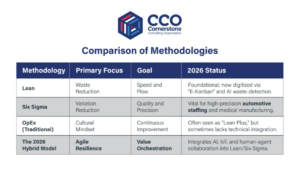
Traditional Lean and Six Sigma frameworks focused primarily on waste elimination and quality control. Today, however, operational excellence firms are integrating digital capabilities, analytics, and automation to create more adaptive operating models.
The Modern Hybrid Model takes the “clutter-clearing” speed of Lean and the “error-proofing” discipline of Six Sigma and wraps them in an AI-governed framework. This allows organizations to maintain quality at scale while being flexible enough to pivot during a supply chain disruption.
Digital Tools for Operational Excellence Services: Dashboards, IoT, and AI in Operations Consulting
A modern business operations firm today is only as good as its technology stack. In 2026, the tools of operations consulting have moved from clipboards to intelligent digital ecosystems known as “Smart Control Towers.”
1. Real-Time KPI Dashboards for Operational Excellence and Operations Consulting
Static monthly reports are obsolete. Modern operational excellence services utilize real-time dashboards that segment data by process, team, and region. These systems use “Magic Links” to pull data from vendors and partners, ensuring a “Single Source of Truth.”
2. IoT and Edge Computing in Manufacturing and Supply Chain Consulting
In manufacturing and logistics, IoT sensors provide the pulse of the operation. By processing data at the “Edge”—on the factory floor or in the delivery truck, businesses can make split-second decisions to avoid downtime.
This capability is increasingly critical in manufacturing management consulting, where operational responsiveness directly impacts throughput and customer satisfaction.
3. Agentic AI and Operational Orchestration in Modern Operations Services
The breakthrough of 2026 is Agentic AI. These are autonomous AI agents that don’t just “report” on a problem, they “orchestrate” a solution. For example, if a shipping delay is detected, the AI can automatically re-prioritize the warehouse picking queue to ensure the highest-priority customers are not affected.
How CCO Implements Operational Excellence Services in Real-World Business Operations
As one of the leading operational excellence consulting firms, CCO Consulting follows a proprietary three-phase implementation roadmap: Stabilize, Optimize, and Orchestrate.
Phase 1: Stabilize – Building the Foundation for Operational Excellence
We begin by eliminating “Digital Clutter.” Using an advanced 5S Methodology, we organize not just the physical workplace, but the digital workflows.
As a leading business operations consulting firm, CCO establishes standardized operating procedures hosted in cloud environments, ensuring operational consistency and scalability.
Phase 2: Optimize – Lean Six Sigma and Workflow Optimization in Operations Consulting
We apply Lean Six Sigma tools to identify the “Critical to Quality” (CTQ) steps. During this phase, we implement workflow automation to remove repetitive manual tasks, freeing up your team for work that requires judgment and creativity.
Phase 3: Orchestrate – AI-Driven Operations and Supply Chain Integration
We integrate AI in supply chain management and operations. This creates a “Connected Ecosystem” where your ERP, CRM, and shop-floor sensors talk to each other. The result is an operation that can “flex” in response to market changes without manual intervention.
KPI Scorecards for Operational Excellence: Measuring What Matters in 2026
To sustain excellence, organizations must measure it effectively. CCO utilizes a Balanced Scorecard approach commonly used by leading strategy firms and operational excellence firms.
The CCO KPI Framework for Operational Excellence Performance
- Process Efficiency: * Cycle Time: The time from order intake to delivery.
- Throughput: Units produced per labor hour.
- Quality & Accuracy:
- First Pass Yield (FPY): Percentage of products that meet standards without rework.
- Defect Rate: Errors per million opportunities.
- Human Capital:
- Workforce Utilization: Time spent on value-added vs. non-value-added tasks.
- Employee Retention: A core indicator of a healthy OpEx culture.
- Financial Impact:
- Cost per Unit: Direct and indirect costs of production.
- ROI of Automation: The measurable savings generated by digital tools.
Operational Excellence FAQ: Key Questions About Operations Consulting and OpEx
Which KPIs matter most in operational excellence?
While revenue is the ultimate goal, the “leading” indicators of success in 2026 are Cycle Time and Perfect Order Rate. If these are trending correctly, financial success generally follows.
How does OpEx differ from Lean?
Lean provides specific tools for waste elimination, but operational excellence services delivered by experienced operations consulting firms establish the leadership behaviors, management systems, and digital infrastructure required to sustain those improvements long-term.
Conclusion: Why Operational Excellence Services Drive Modern Business Transformation
Operational Excellence is not a destination; it is a way of doing business. In 2026, the firms that win are those that can combine the discipline of traditional frameworks with the speed of modern AI.
CCO Consulting is one of the premier strategy firms dedicated to this transformation. We don’t just give you a report; we give you a more resilient, efficient, and profitable future.
Ready to Achieve Operational Excellence?
Stop reacting to disruptions and start predicting them. CCO Consulting provides the operations services, business operations consulting, and operational excellence services required to build a future-ready enterprise
Contact CCO Consulting for an Operational Maturity Assessment




 Uncover the ways we can strengthen your business operations.